Ube has a way of catching the eye before it even reaches the plate. Its purple flesh looks almost theatrical, though its taste is far gentler than its colour suggests. Many people expect something intensely sweet, almost like confectionery, then discover a root vegetable with soft vanilla notes, light nuttiness, earthy depth, and a creamy finish when prepared well. That gap between expectation and reality explains why so many people ask the same thing: what is the best way to consume ube? The real answer is not limited to one recipe. Ube can be mashed, roasted, steamed, blended, baked into desserts, folded into breakfast bowls, turned into spreads, stirred into lattes, or used as a base for richer preparations. Its best use depends on what matters most to you: pure flavour, convenience, nutrition, texture, sweetness, or versatility in the kitchen. A badly chosen format can flatten its character. A well-chosen one makes it shine like velvet under soft light. For someone trying ube for the first time, the goal is simple: choose a form that keeps its taste clear, avoids excessive sugar, and lets its naturally smooth texture come through. That is why the smartest approach is usually to begin with a straightforward preparation, then explore more indulgent options later. The sections below break down how ube behaves, which formats work best, what to avoid, and how to decide which method suits your habits, your palate, and your table.
Why ube tastes better in some forms than others?
Ube is often described as a purple yam, though that short label does not fully explain why it behaves so differently depending on the way it is cooked. Its flavour is delicate rather than loud. That matters because delicate ingredients can disappear quickly when paired with too much sugar, too much dairy, aggressive spices, or artificial flavouring. Anyone searching for the best way to eat ube should start by understanding this point: the ingredient performs best when the recipe supports it rather than buries it. Steaming or boiling the flesh until tender preserves its soft earthy sweetness. Roasting brings a slightly deeper, warmer note, often with a more concentrated finish. Mashing creates the creamy texture many people expect when they hear about ube desserts or ube spread, though that texture is only satisfying if moisture is balanced properly.
Texture is just as important as flavour. Undercooked ube can feel dry or fibrous, which leads some people to think they do not like it when the real issue is technique. Over-processed forms, on the other hand, can become pasty or overly sweet, especially when commercial preparations rely heavily on condensed milk, sugar, colouring, or flavour boosters. The most enjoyable ube consumption often sits somewhere between those extremes. You want tenderness, a creamy mouthfeel, enough richness to feel satisfying, though not so much that the root itself disappears. That is why simple preparations often outperform highly stylised ones. A well-made mash, a balanced halaya, or a gently sweetened breakfast bowl gives you the ingredient itself rather than a purple backdrop for sugar.
Temperature also changes perception. Warm ube tends to express its earthy and nutty side more clearly. Chilled ube, especially in desserts, leans into creaminess and mild sweetness. Blended into a drink, it becomes smoother and more rounded, though sometimes less expressive. Baked into cakes, pastries, or cookies, it can contribute colour and moisture, yet the flavour may become secondary unless the formula is designed carefully. So when people ask for the best method, they are really asking how to preserve the identity of ube while fitting it into food they genuinely want to eat. That balance is the centre of the answer.
Starting with plain cooked ube is often the smartest choice
For a first experience, the best way to consume ube is usually in its simplest cooked form: steamed, boiled, or roasted, then served warm with very light additions. That may sound less exciting than cakes or lattes, though it is the most reliable way to understand what the ingredient actually tastes like. When cooked plainly, ube reveals a soft sweetness that feels calmer than sweet potato, less starchy than potato, and more floral than many root vegetables. The flavour does not rush at you. It unfolds slowly. That is exactly why plain preparation works so well. It gives your palate room to recognise the ingredient before sugar, cream, or toppings start pulling attention away.
Steaming is one of the strongest options because it keeps the flesh moist without washing flavour away. Boiling works well too, especially if the pieces are evenly cut and removed as soon as they become tender. Roasting brings more character, particularly for people who prefer deeper, more caramel-like notes. Once cooked, ube can be eaten on its own, lightly mashed with a little coconut milk, or paired with yoghurt, porridge, oats, or rice. A small pinch of salt often helps more than extra sugar, because salt sharpens the existing sweetness rather than replacing it. This is also where many people discover that ube does not need to be treated like confectionery to be enjoyable. It can sit comfortably in breakfast, snacks, and side dishes without turning into a dessert every time.
The practical advantage is obvious as well. Simple cooked ube gives you control. You decide the sweetness, the texture, the fat content, the portion size, and the overall direction of the dish. That control matters if you want a more natural approach or if you want to use ube regularly rather than as an occasional novelty. It is also the format that translates most easily into other recipes later. Once you have plain cooked flesh or a neutral mash ready, you can build it into pancakes, chilled creams, toast toppings, bakes, or even a more elaborate dessert. Starting simple is not a compromise. It is the clearest route to discovering whether you enjoy ube for what it is rather than for what sugar makes it become.
Sweet dishes work well, though balance matters more than sugar
Many people first meet ube through sweet recipes, which makes sense because its colour is memorable and its creamy finish fits beautifully into desserts. The trouble starts when sweetness takes over completely. A lot of commercial products push ube into a very sugary corner, which can create the impression that the ingredient itself is candy-like. It is not. In reality, the best sweet use of ube is a balanced one, where sweetness supports the purple yam rather than smothering it. This is why classics such as ube halaya, custards, ice cream, cheesecakes, sponge cakes, and filled buns can be excellent choices when they are made with restraint. The colour already carries visual drama. The flavour does not need shouting.
A well-made ube dessert usually relies on three things: enough fat to carry flavour, enough sweetness to soften the earthy edge, and enough structural care to stop the texture turning heavy. Coconut milk, evaporated milk, cream, butter, and egg-based mixtures often pair well because they round off the root’s natural starchiness. Still, overloading these components can create a dense or cloying result. The best spoonful should feel smooth, lightly rich, and distinct. You should still recognise the ingredient under the sweetness. That principle matters whether you are eating a chilled slice of ube cake, a breakfast pastry, a mousse-like filling, or a homemade jam-style spread on toast.
There is another reason sweet dishes remain popular: they make ube approachable for people who are unsure what to expect. Someone who might hesitate at a plain root vegetable often feels more comfortable trying a soft bun, a scoop of ice cream, or a creamy jar spread. That can be a very good entry point, provided the product is made thoughtfully. Choosing desserts with shorter ingredient lists, less colouring, and a clear purple yam base usually leads to a better experience. The best sweet format is not the one with the brightest shade or the heaviest topping. It is the one that still allows the ingredient’s natural softness, nuttiness, and mellow depth to come through. In that sense, sugar should behave like lighting in a theatre: it should illuminate the main character, not replace it.
What works best in drinks, breakfasts and easy everyday meals?
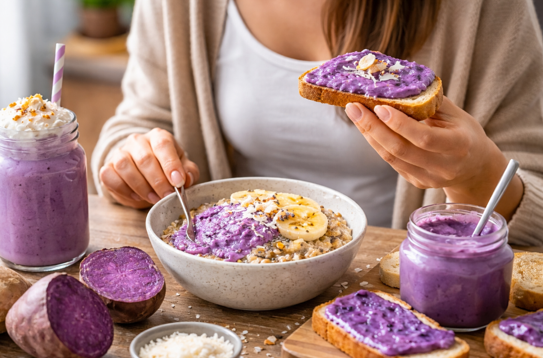
Not everyone wants to bake or prepare elaborate desserts, which is why ube is often most successful when folded into simple daily eating habits. Breakfast is one of the easiest places to begin. A spoonful of mashed ube stirred into oats adds colour, body, and a subtle sweetness that pairs nicely with coconut, banana, cinnamon, or plain yoghurt. Spread on toast with a little butter or soft cheese, it creates contrast between richness and earthiness. Blended into a smoothie, it gives thickness and a dessert-like feel without necessarily requiring heavy sweetening. For people who prefer warm drinks, an ube latte can be pleasant, especially when the preparation uses real ube purée or powder instead of relying entirely on syrup. The result should feel smooth and mellow rather than tasting like a sweet shop.
One everyday advantage of ube is its adaptability. It can move from morning to afternoon without feeling out of place. Mixed into pancake batter, swirled through rice pudding, folded into a chia bowl, or used as a filling for soft pastries, it behaves like an ingredient that enjoys company but does not demand constant attention. That makes it appealing for home cooks who want variety without complexity. The key is to match the format with the texture you want. Smooth purée suits drinks, spreads, porridge, and creams. Chunkier cooked pieces work better in bowls and plated dishes. Powdered ube can be convenient for baking and beverages, though it should have a clean ingredient profile if you want a more authentic result.
Best pairings for flavour
The most reliable pairings tend to be gentle rather than aggressive. Coconut is perhaps the best-known companion because its richness supports ube without dominating it. Dairy can work well too, particularly in creamier formats, though the fat level should not become so high that the root disappears. Vanilla is helpful in very small quantities. Salt, often underestimated, sharpens sweetness and gives the whole dish a clearer outline. Fruits such as banana and mango can work, though strong acidity may overpower the yam’s softer notes. Nuts, especially those with buttery or lightly toasted profiles, often match its depth. These combinations matter because the best way to consume ube is rarely about the ingredient in isolation. It is about building a setting where the flavour can be heard clearly.
Formats that suit busy routines
For people with limited time, convenience matters almost as much as taste. These are some of the easiest forms to work into a normal routine:
- Purée
- Powder
- Spread
- Porridge
- Smoothies
- Pancakes
- Toast
- Yoghurt
Those formats are practical because they require very little adaptation. A prepared purée can be portioned and chilled. Powder can be whisked into batter or warm milk. Spread can go straight onto bread. A breakfast bowl can take a spoonful without changing the whole recipe. The best daily use of ube is often the one you will actually repeat, which means taste, ease, cost, and preparation time all need to align. A brilliant recipe you make once is less useful than a simple format you enjoy every week.
See also: The Tech Behind Online Bus Ticket Booking Systems
Which form of ube should you choose: fresh, powder, purée or spread?
The best way to consume ube also depends on which form you can buy. Fresh ube usually offers the most authentic flavour and gives the greatest freedom in the kitchen, though it requires peeling, cooking, and a bit of patience. Its texture and taste can vary from one root to another, which is part of the charm. For people who enjoy cooking from scratch, fresh is often the strongest option. It lets you steam, roast, boil, mash, or bake with a direct sense of the ingredient. That directness matters when the goal is flavour clarity rather than convenience alone.
Ube powder is attractive because it stores well and works quickly in drinks, batters, frostings, and dessert fillings. The quality gap between products can be large, however. Some powders are closer to dehydrated purple yam. Others are heavily sweetened or artificially flavoured. Reading the ingredient list is essential. If the powder is clean and focused, it can be a practical tool. If it is full of extras, the final result may taste more manufactured than natural. Ube purée sits in a very useful middle ground. It offers convenience while staying closer to the texture and flavour of cooked flesh. It can be stirred into bowls, spooned into desserts, or used as the base for spreads and creams. For many home cooks, purée is arguably the most versatile format.
Ube spread is the easiest option for immediate use, especially on toast, pastries, or breakfast dishes. Its weakness is that it is often one of the sweetest forms on the market. That does not make it a poor choice, though it does mean selection matters. A good spread should taste like ube first, sweetness second. For most people, the best choice depends on the role they want the ingredient to play. Choose fresh if you want authenticity and control. Choose purée if you want flexibility with less effort. Choose powder if you mainly want drinks and baking convenience. Choose spread if you want the fastest route to enjoying it with minimal preparation. None of these options is universally best. The best one is the version that preserves flavour while fitting naturally into the way you cook and eat.
Common mistakes that make ube less enjoyable
People sometimes decide they do not like ube when they have really just had a poor version of it. One common mistake is expecting an intense flavour. Because the colour is vivid, many assume the taste will be dramatic too. When the flavour turns out to be subtle, they keep adding sugar, flavourings, toppings, syrups, or spices until the original ingredient disappears. Another common mistake is choosing products that are designed more for appearance than taste. Bright purple desserts can look stunning, though some rely so heavily on colouring and sweetness that the result tells you almost nothing about real ube.
Cooking errors matter too. Fresh ube needs proper softening. If it remains firm, the texture can feel chalky or fibrous. If it is blended carelessly without enough moisture, the purée may become stiff and heavy. If too much liquid is added, the flavour can weaken. Balance is everything. There is also the question of pairing. Strong chocolate, sharp citrus, aggressive spice blends, or very salty toppings can pull attention away from the yam’s more nuanced profile. This is an ingredient that rewards a measured hand. It does not ask for silence, though it does ask for space.
The last mistake is treating every use of ube as a dessert project. Sweet preparations are valid and often delicious, though they are not the only route. People who try it only in frosted cakes or syrupy drinks may miss how satisfying it can be in calmer formats such as warm mash, breakfast bowls, gentle spreads, or lightly sweetened bakes. The best method of consuming ube is often the one that respects its identity. Once that principle is clear, the ingredient becomes far easier to enjoy and far easier to use well.
A simple way to decide what suits you best
If your priority is discovering the real taste of ube, start with plain cooked flesh or a lightly seasoned mash. If you want comfort and indulgence, choose a balanced dessert where sweetness stays under control. If convenience matters most, purée or a good-quality spread makes everyday use far easier. Drinks, breakfasts, and soft baked recipes also work beautifully when the ingredient is allowed to remain recognisable. In most cases, the best way to consume ube is the one that preserves its creamy texture, keeps sweetness in check, and fits naturally into your habits. If you have not tried it yet, the smartest first step is often the simplest one: taste it in a form that lets the purple yam speak clearly, then decide where you want to take it next.